A JOURNEY TO HAMBURG: WHERE STRAW, SOUND & STEINWAY MEET
There are worse ways to spend a Monday than flying to Hamburg to admire some of the world's most beautiful pianos.
Mercifully, this particular adventure did not require a dawn raid on Heathrow. Our British Airways flight departed from Terminal 5 at the entirely civilised hour of 11.05am, allowing for coffee, newspapers and the comforting illusion that one is travelling for pleasure rather than work. By early afternoon we had landed in Hamburg, Germany's quietly sophisticated second city and home to one of the two Steinway & Sons factories in the world.
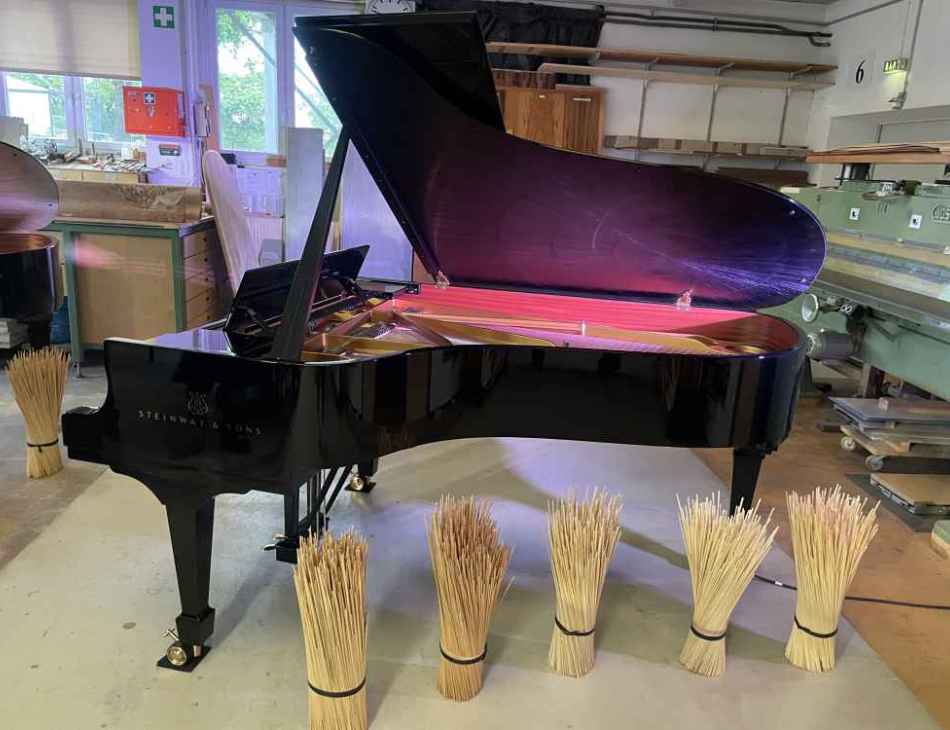
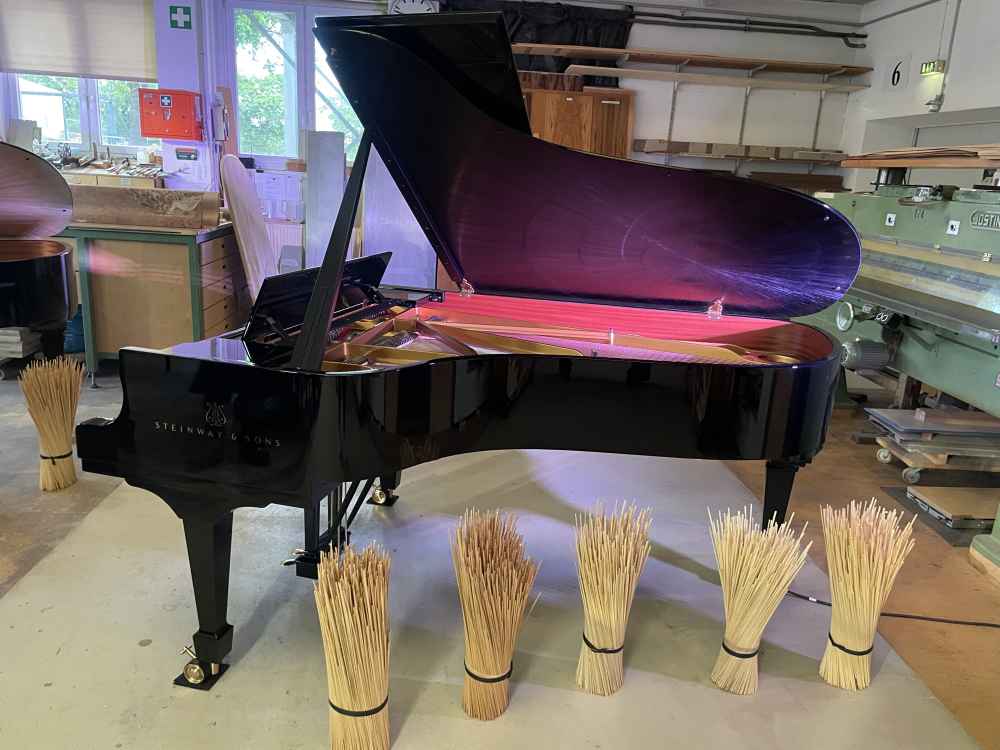
The occasion was the unveiling of Steinway's latest Masterpiece Collection, created in collaboration with Lyon-based Studio Paelis, specialists in the ancient craft of straw marquetry. It is not every day that a luxury piano manufacturer announces a collection featuring rye straw as its defining decorative element - but then Steinway has never been a company particularly interested in ordinary.
After arriving and checking in at the achingly cool Gastwerk Hotel (a former gasworks transformed into one of the city's more characterful places to stay), we were soon ushered into a coach to travel to the Steinway factory for an evening of dining and the official unveiling.
The collaboration itself marks a first for Steinway, as never before has the company partnered with a straw marquetry studio. Founded by the award-winning Manon Bouvier-Toth (one of France’s celebrated Meilleurs Ouvriers de France), Studio Paelis has become renowned for reviving and reimagining a centuries-old decorative art form that dates back to seventeenth-century Europe. Using rye straw sourced from Burgundy, each strand is split, flattened and applied by hand to create intricate patterns that shimmer with a naturally metallic lustre that was stunning to look at.
The result is extraordinary, giving the piano a finish that sits somewhere between silk, lacquer and burnished metal.
Two designs have been created for the collection. The first, Classic Sunburst, radiates outward in golden rays across the piano's interior surfaces. The second, Concentric Waves, takes inspiration from sound itself, creating rippling circular patterns that seem to visualise music as it travels through the air. Each design is available in natural, black and blue colourways, transforming the inside lid and music desk into works of decorative art.
Listening to Manon Bouvier-Toth speak about the project, it became clear that this was far more than a decorative exercise. For Studio Paelis, working on a piano represented an entirely new challenge: the scale, curves and physical demands of the instrument required the atelier to rethink its techniques. Each piano demands approximately a month of dedicated marquetry work by a single artisan, and in a world increasingly dominated by automation, such figures feel almost rebellious.
The evening concluded with dinner (on placemats made from the same aged wood as a piano – luckily I managed snag a set of 4!) and a demonstration of Steinway's remarkable Spirio system, which allows performances to be captured and reproduced with astonishing fidelity. I couldn't help noticing the delicious contradiction at the heart of the evening: centuries-old handcraft presented alongside state-of-the-art digital engineering. Watching a concert grand seemingly play itself remains one of those experiences that sits somewhere between engineering marvel and outright sorcery! The sound, meanwhile, was simply impeccable.
The following morning offered what many guests had secretly been anticipating all along: a tour of the Hamburg factory itself.
Founded in 1880, the Hamburg facility has been producing Steinway pianos for almost 150 years. The wider Steinway story begins even earlier, in 1836, when Heinrich Engelhard Steinweg built his first piano in the kitchen of his home in Germany. After emigrating to the United States, he anglicised his surname to Steinway and founded Steinway & Sons in New York in 1853. The company would go on to secure more than 140 patents and fundamentally shape the modern piano as we know it.
Walking through the Hamburg factory is to witness a rare survival: industrial craftsmanship operating at a genuinely artisanal level, with time becoming part of the instrument and story.
We learned, for instance, that the woods used in Steinway pianos undergo years of preparation before they are ever shaped into an instrument. The natural drying process alone takes approximately two years according to Steinway’s official figures, though several craftsmen explained that selected woods may effectively season for closer to five years before reaching the workshop floor, depending on their intended use and characteristics. In an era where entire apartment blocks appear to be constructed in roughly eleven days, this felt quietly astonishing.
A Steinway grand piano takes approximately a year to build. The process involves around 12,000 individual components, countless hours of skilled handwork and a level of attention to detail that borders on obsession.
Spruce is used for the soundboards and keyboards; maple features in the pin block, action parts and bridges; mahogany and maple veneers form the rim. The famous Steinway rim itself consists of up to 20 layers of hardwood bent into shape in a single process. Everywhere one looked, there were components in various stages of becoming - frames, strings, bent rims, polished cases - each waiting for the next pair of skilled hands.
And hands matter here. Deeply.
Despite this painstaking approach, the Hamburg factory maintains a surprisingly consistent output. Approximately four to five pianos leave the factory each day, resulting in annual production of around 1,200 instruments. In manufacturing terms, these are vanishingly small numbers. In luxury terms, they represent exclusivity earned rather than engineered.
The most popular model, we were told, is the Model B. At 211cm in length, it strikes a balance between concert-hall performance and domestic practicality, making it the bestselling piano in the Steinway range. Unsurprisingly, it also forms the basis of much of the new Straw Marquetry Collection.
There is something deeply moving about watching objects of such precision emerge through human skill rather than pure automation. One craftsman spent what seemed an eternity adjusting tiny mechanical tolerances that most owners will never consciously notice. Another polished lacquer to a mirror finish so flawless it borders on perfection!
And yet the tour’s emotional climax came not on the factory floor but at its conclusion: the 'Selection Room'.
Among pianists, the Selection Room occupies almost mythical status. This is where artists choose their instruments - not merely by specification, but by personality, touch and voice. Rows of finished pianos wait in quiet formation, each subtly different despite identical models and measurements. The room itself carries an almost chapel-like atmosphere. Conversations instinctively soften. Even the most hardened visitors seem to stand a little straighter.
To understand its importance, one must appreciate a fundamental truth about Steinways: no two are exactly alike.
Each piano possesses its own personality, voice and character. The Selection Room provides the opportunity to sit at multiple instruments of the same model and discover the one that speaks most directly to its future owner. It is a process that combines technical evaluation with something far more instinctive, rather like an extremely expensive and acoustically gifted form of matchmaking.
For concert pianists, this moment can shape years of performances. For private collectors, it may represent the culmination of a lifelong ambition. For families, it can become the beginning of a musical legacy that extends across generations.
As our visit drew to a close and we headed back towards Hamburg Airport, I found myself reflecting on the unlikely combination at the heart of the trip. Straw and piano. Ancient decorative craft and modern musical engineering. A French marquetry atelier and a German factory whose roots stretch back to the nineteenth century.
Yet somehow the partnership makes perfect sense! Both Studio Paelis and Steinway operate according to principles that feel increasingly rare: patience, mastery and a belief that true luxury lies not in excess but in excellence.
The Straw Marquetry Collection may have brought us to Hamburg, but it was the deeper story of craftsmanship - measured not in hours or days, but in years and generations - that lingered long after the final note had faded.