

Toyota Land Cruiser 48v: Electrified But Only Mildly
Toyota Has Added Mild-Hybrid Assistance To Its Big, Honest Off-Roader. The Result Is Not A Revolution But Then A Revolution Was Never Really The Point.
Toyota Land Cruiser 48v
There are some vehicles that suit Salisbury Plain. A Porsche 911 does not. A Bentley Flying Spur might, provided you had someone following in a support vehicle with a calming herbal tea. A Fiat 500 would just look as though it had taken a wrong turn on the way to a garden centre.
The Toyota Land Cruiser, however, looks entirely at home.
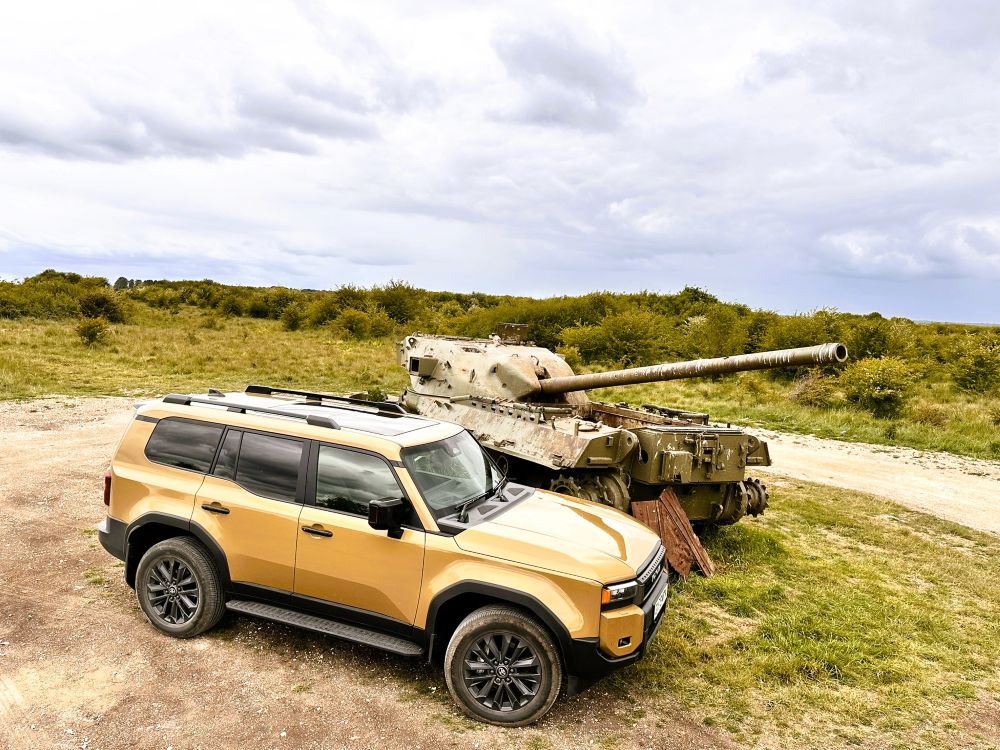
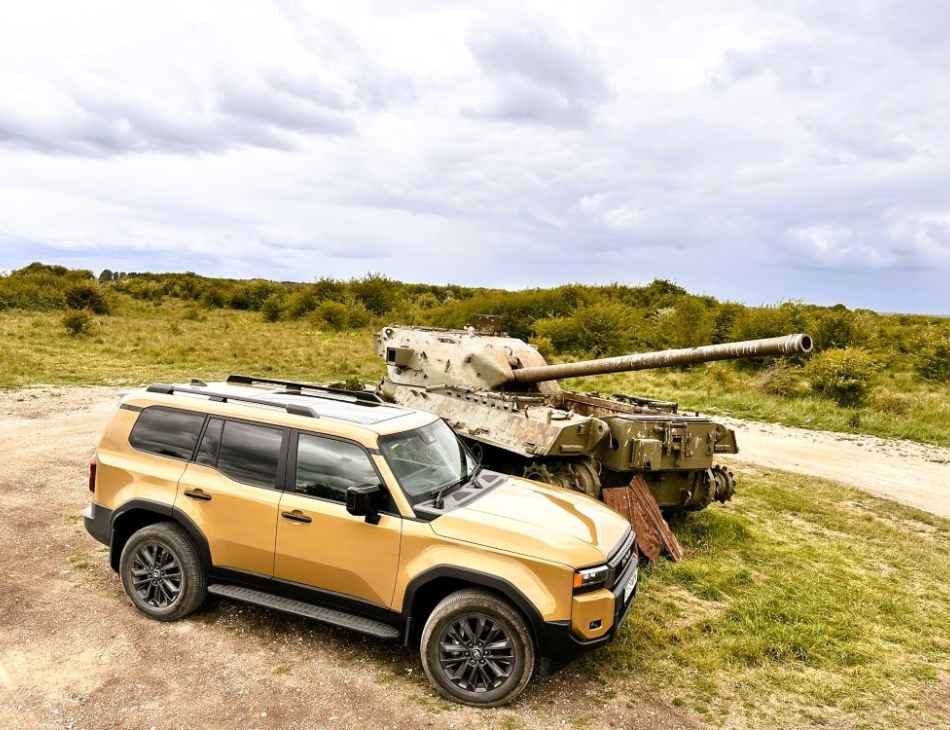
In fact, parked beside that old Chieftain, under a suitably British sky that appeared to be considering rain, war, drizzle and mild disappointment all at once, the Land Cruiser seemed like part of the landscape. Large, square, mustard-sand coloured and faintly indestructible, it could even have been issued rather than delivered.
The Land Cruiser has never really been about fashion, though this latest one does have an unexpected amount of visual swagger. It has not been designed to loiter outside expensive coffee shops wearing piano-black jewellery and pretending to be sporty. It is a proper thing. A body-on-frame, permanent four-wheel-drive, diff-locking, low-range, wading, towing, climbing device for people who either need serious capability or enjoy knowing that they have it.
Last year I drove the then-new Land Cruiser and came away rather fond of it. It was big, honest, slightly agricultural in the right places and surprisingly plush in others. It was a car full of grab handles, switches and practical intent. It felt as if someone at Toyota had remembered that not every SUV needs to behave like a luxury handbag on 22-inch wheels.
Now, however, Toyota has added something modern to the mix: a 48V mild-hybrid system.
At which point you may reasonably ask: what on earth does that mean? This is where the modern motoring world becomes unnecessarily confusing. We now have mild hybrids, self-charging hybrids, plug-in hybrids, electric vehicles and somewhere in the corner, a chap still insisting that diesel is not dead, merely misunderstood.
A plug-in hybrid is the one most people understand. It has a sizeable battery, can be charged from the mains and can usually travel a useful distance on electric power alone. A self-charging hybrid, Toyota’s long-standing speciality, uses a petrol engine and electric motor working together, with the battery replenished through braking and the engine. You do not plug it in, but it can move on electric power in short bursts.
A mild hybrid is much more modest. It cannot drive around as an electric vehicle. It will not waft silently through town for 40 miles while you polish your environmental halo. Instead, it uses a smaller battery and motor-generator to assist the engine, recover energy when slowing down, smooth out stop-start operations and provide a little additional support when pulling away.
In the Land Cruiser’s case, the system consists of a 48V lithium-ion battery, an electric motor-generator and a DC-DC converter, attached to the familiar 2.8-litre four-cylinder turbodiesel. The power figure remains 202bhp. Torque remains 500Nm. Towing capacity remains 3.5 tonnes. The official fuel economy is now listed at between 25.9 and 26.4mpg, with CO₂ emissions of 282g/km. The 0–62mph time is 12.3 seconds.
So yes, if you are reading those numbers and thinking this does not sound like the sort of electrification that will make Greta Thunberg punch the air in celebration, you are probably right.
In fact, compared with the version I drove before, the 48V Land Cruiser feels almost exactly the same. Not similar. Not broadly familiar. The same. I had it for a week and used it mainly for work, which meant cities, ordinary roads, traffic and the sort of everyday British driving that turns even the noblest off-roader into a mobile waiting room.
And through all of that, the mild-hybrid system did what mild-hybrid systems tend to do when they are behaving properly: almost nothing obvious.
That is both a criticism and a compliment.
It does not suddenly make the Land Cruiser feel brisk. It does not add a little sparkle to the throttle pedal or transform it into something eager. It remains a large, heavy diesel 4x4 with the acceleration of a canal boat. Put your foot down and there is progress, but it is the sort of progress that comes with paperwork. The engine gathers itself, the eight-speed automatic sorts out the logistics and the scenery eventually begins moving towards you at a sensible rate.
But it also does not make the Land Cruiser worse. There is no strange interference from the electrical system, no artificial lurching, no odd sensation of the drivetrain arguing with itself. The stop-start function is smoother and less intrusive than it otherwise might be in a big diesel and moving away from rest feels calm and measured. In traffic, it does make sense.
The question is whether that is enough.
If you are an existing Land Cruiser customer thinking about swapping from the old non-48V version into this one, I am not sure the numbers alone make an entirely persuasive argument. It is heavier. It is slower to 62mph. The economy gain is marginal and the CO₂ figure remains in the same broad territory. And because the Land Cruiser is the sort of vehicle people buy for decades rather than fashion cycles, I suspect many owners will look at the mild-hybrid badge, nod politely and ask whether it still tows, wades and refuses to die (which it does).
And that is where this car begins to make sense again.
Because while the 48V element is the headline update, it is not really the soul of the thing. The soul is still the Land Cruiser itself. It remains vast, upright and refreshingly unashamed of its purpose. At 4,925mm long, 1,980mm wide and 1,935mm tall, this is not a small machine. It has the stance of something carved rather than styled, with a square jaw, upright glasshouse, broad shoulders and a face dominated by the word TOYOTA, written across the grille.
I like that.
The colour of my test car helped enormously. In this sandy bronze shade, photographed out on Salisbury Plain, it looked properly expedition ready. There is a pleasingly military honesty to the shape, particularly from the front three-quarter angle. The bonnet is broad and flat, the lights are squared off and purposeful and the black cladding gives it the air of something designed to be rinsed down rather than delicately detailed with a lambswool mitt.
Previous Land Cruiser incarnations were capable, of course they were but they did not have quite the same visual confidence. This one does. It manages to look retro without becoming cartoonish, modern without becoming fussy and expensive without looking precious. That is a difficult trick.
Inside, the same philosophy continues. If you are expecting a minimalist Scandinavian lounge with a single touchscreen and a steering wheel, look elsewhere. The Land Cruiser’s cabin has buttons. Lots of buttons. Wonderful buttons. Buttons for drive modes, terrain modes, differential locks, hill descent, cameras, ride settings and various other functions that make you feel as though you are preparing to cross a mountain range.
I am firmly in favour of this.
Touchscreens are fine for radio stations and phone pairing. They are less fine when you are trying to operate something important while bouncing along a rocky road. The Land Cruiser’s interior feels deliberately functional. The controls are large, clear and sensibly arranged. There are proper grab handles, chunky switchgear and a general sense that the cabin has been designed by people who understand off-roading.
It is also much plusher than the word “utility” might suggest. The leather seats are broad and comfortable, the driving position is commanding and the cabin is enormous. There is a 12.3-inch touchscreen, a digital driver display, a head-up display, a JBL sound system, heated and ventilated seats and enough equipment to remind you that this is not some stripped-out farm truck. It is a premium off-roader but not one that has forgotten what the word “off-roader” means. I think that distinction matters.
Many modern SUVs are really estate cars with inflated egos. They have off-road modes that adjust throttle mapping for the treacherous conditions found in Waitrose overflow parking. The Land Cruiser is different. It has permanent four-wheel drive, high and low-range gearing, an electronic rear differential lock, Crawl Control, Multi-Terrain Select, Multi-Terrain Monitor and Toyota’s Stabiliser Disconnect Mechanism, which can disengage the front anti-roll bar to improve wheel articulation over rough ground.
I did not spend the week attempting to invade a neighbouring county, but Salisbury Plain is a useful reminder of what this vehicle is about. Even just being there, among chalk tracks, military relics and open land, the Toyota made sense. There are cars that feel slightly ridiculous when removed from the urban environment. The Land Cruiser feels slightly ridiculous when trapped inside one.
And yet it copes.
In town, it is big, but not terrifying. The steering is light enough, the visibility is excellent and the camera systems help enormously. You are always aware of its size, particularly its width, but the square corners make it easier to place than some supposedly more city-friendly SUVs with sloping glass and mystery bodywork. It is not delicate, but it is manageable.
The ride is also better than you might expect from something with such serious hardware underneath. There is still a body-on-frame firmness to it, and you are never allowed to forget that you are driving something substantial but it does not crash about or feel crude. On longer journeys, it settles into a relaxed rhythm. The engine is present but not uncouth, the gearbox is smooth and the general experience is one of steady, unhurried confidence.
This, rather than speed or electrification, is the Land Cruiser’s great appeal. It makes you feel as though nothing much will trouble it. Potholes, weather, rough tracks, bad roads, heavy loads, awkward fields, long distances and the collapse of society all seem like minor inconveniences.
Less reassuring are some of the driver assistance systems though.
Now, I understand why they exist. Toyota’s safety suite is comprehensive and on paper, impressive. The car can monitor lanes, traffic, driver attention, blind spots, vehicles crossing ahead and all manner of potential hazards. This is good. Nobody sensible is against safety.
But there is a difference between assistance and nagging.
The Land Cruiser can be a little too enthusiastic in this department. On narrow British roads, where the correct driving line is often dictated by hedges, vans, cyclists and tractors, the systems can become rather busy. Warnings appear. Bongs happen. The car fails to identify your face. It suggests you take a break. Then, not long after, it suggests you take another one.
There is something faintly absurd about a vehicle that can tow 3.5 tonnes and scramble over hostile terrain becoming concerned because you glanced sideways at a roundabout.
Still, most of these systems can be managed, adjusted or silenced once you have spent enough time with the menus. And perhaps this is simply the price of modern motoring. Even the Land Cruiser, that most old-school of machines, must now live in a world of sensors, software and regulatory anxiety.
Which brings us back to the 48V system.
Is it worth it? As a transformative piece of technology, no. It does not change the character of the Land Cruiser. It does not make it fast, frugal or futuristic. It does not suddenly reposition it as a clean-living urban family wagon for people who discuss oat milk intensity.
But as a subtle addition to an existing formula, it is perfectly acceptable. It smooths things out slightly, helps the stop-start system behave with more decorum and gives Toyota a small efficiency improvement without compromising the Land Cruiser’s core abilities. Crucially, it does not interfere with the reason people buy these things in the first place.
And that, I think, is the correct way to view it.
The electrification here is not the story. The Land Cruiser is the story. The 48V system is a footnote, albeit one Toyota would quite like you to read carefully. This remains a hugely capable, likeable, slightly stubborn machine with proper off-road credentials, a fabulous sense of purpose and an interior that understands the enduring joy of a physical button.
It is not perfect. It is expensive, thirsty, slow and occasionally too keen to warn you about things you already know. The mild-hybrid system offers only marginal gains and may not be enough to tempt existing owners out of perfectly good earlier examples.
But I still rather love it.
Because in a market full of SUVs pretending to be adventurous, the Land Cruiser is one of the few that actually is. The addition of 48V technology has not turned it into something new and nor should it have done. It has merely nudged it gently towards modernity while leaving the important bits alone.
Toyota has electrified the Land Cruiser, then. Mildly. Very mildly.
Model: Toyota Land Cruiser 48v
Base Price: £80,984
Propulsion: 2.8-Litre, 4 Cylinder In-Line
Transmission: 8-Speed Direct Shift Automatic
Drivetrain: Four Wheel Drive
Output: 202bhp
Torque: 500Nm
0-62 mph: 12.3 Seconds
Top Speed: 105mph
Combined Cycle: 25.9mpg
C02 Emissions: 282g/km
Kerb Weight: 2,415kg